
Newsletter 23

Giving agents a notebook tool with marimo pair, a notebook competition, and more ...

You’re reading the 23rd marimo newsletter. In this newsletter, we’ll cover our biggest launch of the year — marimo pair — along with other new features, a notebook competition, and community highlights.
marimo pair. Today we’re launching marimo pair, a skill that drops agents inside a running marimo notebook session, giving them full control over the notebook. Agents can do anything humans do in the notebook and more: executing code, inspecting data in memory, and manipulating the user interface.
Features. Since the last newsletter, we shipped 8 releases including a new remote storage panel, reactive Matplotlib selections, editable matrix inputs, a rich PyTorch module display, ipynb export from the editor, slide PDF export, a unified table explorer, and much more.
Community events. We have three events this month.
- April 9. First community call of the year. Register here!
- April 26. Submission deadline for our first ever notebook competition with alphaXiv. Prizes include a Mac Mini and gift cards.
- April 30. An in-person meetup with alphaXiv in San Francisco: come for demos from both teams, winner announcements, and community connections. Space is limited; register soon!
#Introducing marimo pair
marimo pair makes agents active participants in research and data work for the first time, giving them full control of a running notebook session. This lets you collaborate with agents on a shared canvas, while also giving agents access to a reactive REPL that eliminates hidden state and guarantees reproducible Python programs.
Quickstart: marimo pair is an agent skill hosted on GitHub. Get started with:
npx skills add marimo-team/marimo-pair
/marimo-pair pair with me on my_notebook.py
Use cases: Here are just a few use cases:
- Exploratory data analysis. Agents can inspect datasets, find anomalies, build visualizations, and even manipulate interactive plots on your behalf.
- Autoresearch. Collaboratively identify promising experiments, then unleash agents to optimize metrics autonomously.
- Implement a paper. Give an agent a link to a paper and have it generate an educational notebook using our paper skill.
- Data engineering. Join tables, query data, and build pipelines without ever describing schemas to your agent.
Read the full announcement at our blog..
#Notebook competition
We’ve partnered with alphaXiv to run a notebook competition challenging you to implement AI research papers as interactive marimo notebooks.
- Deadline: April 26, 11:59 PM PST
- Winners event: April 30 in San Francisco (virtual attendance available)
- Prizes: Mac Mini + gift cards for 1st place, gift cards + marimo swag for runners-up
- How to enter: Pick a paper from alphaXiv’s curated selection (or your own), build a marimo notebook demonstrating the core idea, and submit via the official form
The judges favor notebooks that provide intuitive understanding through code, UI, and explanatory text. Bonus points for novel extensions or algorithm variants.
#New features
We shipped 8 releases since the last newsletter. marimo 0.20.0 was a particularly big one; here are highlights from that release and others.
#Remote storage
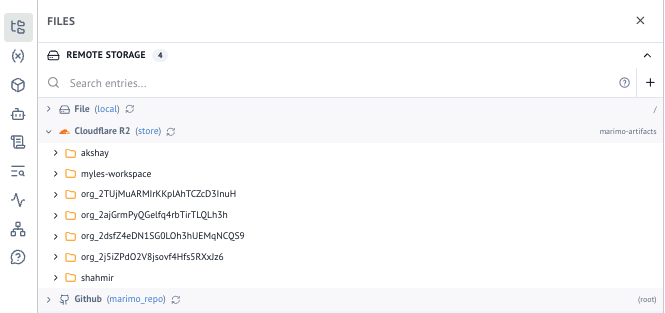
marimo now makes it easy to work with cloud storage and remote filesystems by automatically detecting obstore and fsspec storage connections in your notebook. From the Files panel, you can browse directories, search entries, copy URLs, and download files without leaving the editor. Read the docs to learn more.
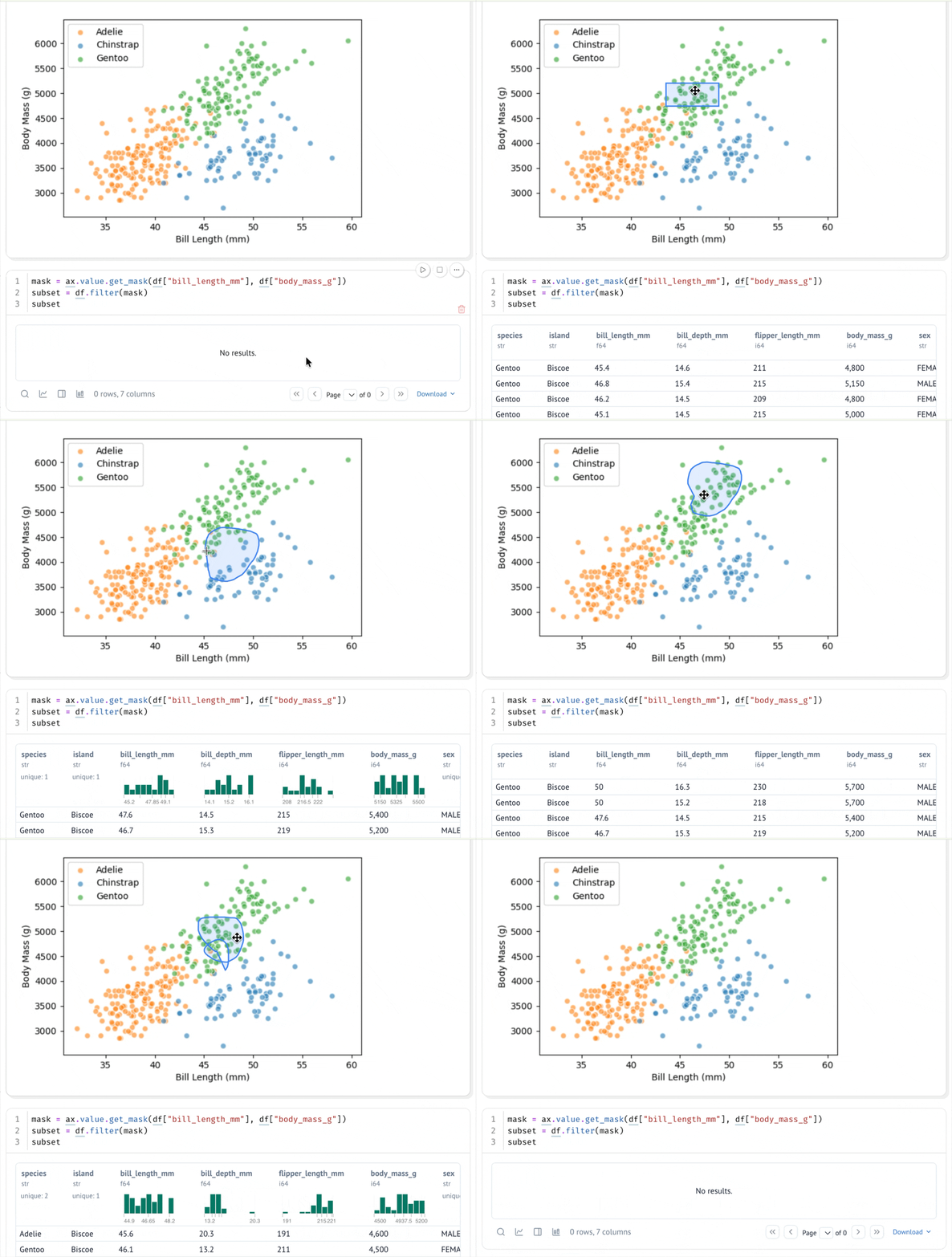
#Reactive Matplotlib selections
mo.ui.matplotlib
adds reactive box and lasso selection to Matplotlib scatter plots. Box-select by
default, Shift+click for lasso — selected points map back to your Python data.
(Try it on molab.)
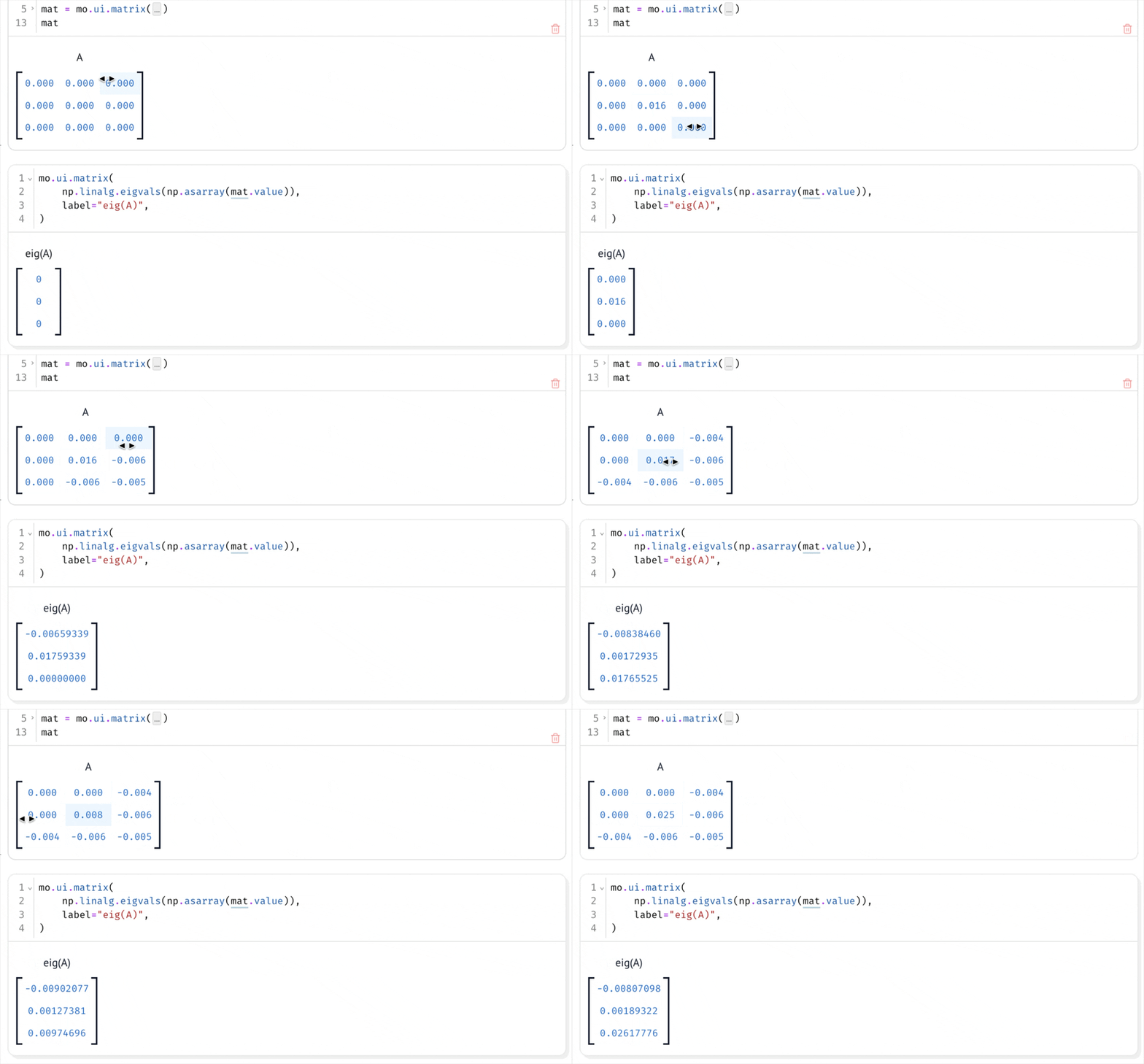
#Editable matrix and vector inputs
mo.ui.matrix
provides interactive numeric grid inputs. Initialize with a nested list or NumPy
array and get a reactive element that updates as the user edits cells. Supports
per-element bounds, symmetric constraints, and custom precision.
(Try it on molab.)
#Rich PyTorch nn.Module display
PyTorch nn.Module instances now render as collapsible HTML trees with
color-coded layer categories. Frozen layers are visually dimmed with trainable
parameter counts shown inline.
(Try it on molab.)
#Other highlights
- Download notebooks as ipynb. Export to
.ipynbfrom the editor’s download menu, with cells in visual order and captured outputs. - Slide PDF export. Export slide-layout notebooks to PDF with
marimo export pdf --as=slides. The--rasterize-outputsflag captures interactive widgets as images. - Unified table explorer. The row viewer and column explorer are now a single tabbed pane, with smart numeric formatting.
- Summary statistics. Select cells in a data table to see count, sum, and average, spreadsheet-style.
- Smart minimap previews. The dependency minimap now shows actual SQL and markdown content instead of boilerplate.
- Ruff config discovery. Notebook cell formatting now picks up your project’s Ruff configuration.
All changelogs: 0.20.0, 0.20.3, 0.21.0, 0.22.0.
#🍃 Community
We’re at 20k+ GitHub stars, 230+ contributors, and 3.6k+ members in Discord — join the conversation!
Here are some mentions of marimo in the wild that we found particularly inspiring.
- Half marathon app. Sofía Rodriguez built an interactive half marathon analysis app for the Buenos Aires Half Marathon via DataTalks, powered by marimo
- Chaos theory visualizations. Kartikeswar Rana created interactive nonlinear dynamics and chaos theory visualizations — explore bifurcation diagrams, strange attractors, and more
- Homography notebook. Gal Winer wrote a blog post and interactive notebook exploring homographies in computer vision with linear algebra
- Rainbow is All You Need. A popular DQN tutorial series (2k+ GitHub stars) was migrated to marimo, bringing interactive deep reinforcement learning education to marimo notebooks
- Incremental data pipelines with Apache Iceberg. Gianluca Sara at Giorgio Armani published a deep dive on safely rebuilding incremental pipelines using Apache Iceberg’s WAP branches, built with marimo
- Market Microstructure Forensics. Kambiz Homayounfar built a computational essay on manipulative trading behavior in Japanese financial markets as a training tool for regulators
Don’t forget to check out our curated community gallery. Share your molab notebooks on social media and tag us for a chance to be featured!
Sincerely, marimo team 🍃