Newsletter 26

Our first launch week, Google Drive on molab, training coding agents, and why Voltus chose marimo

You’re reading the 26th marimo newsletter. In this (packed!) newsletter, we recap last week’s launch week, show how you can train coding agents on molab, explain why North America’s number one virtual power plant aggregator chose to build on marimo, enumerate new features in open source, and of course put a spotlight on what our community is building with marimo.
#Launch week
Last week we held marimo’s first-ever launch week, announcing a new feature each day. An abridged recap follows; for the full story, read our blog or watch the recap video.
Monday: marimo pair. marimo pair, which transforms your notebook into a collaborative thinking canvas for you and your AI agents, now supports Cursor and VSCode. It also has a new landing page at marimo.io/pair. For a technical deep dive, see Trevor’s blog post, and for a product overview see our YouTube video.
Tuesday: marimo anywhere. Publish marimo notebooks anywhere on the web with three new and improved open-source integrations: quarto-marimo, jupyter-book-marimo, and mdx-marimo. Embed live, reactive Python cells into Quarto sites, Jupyter Books, and anything built with MDX (blog, video).
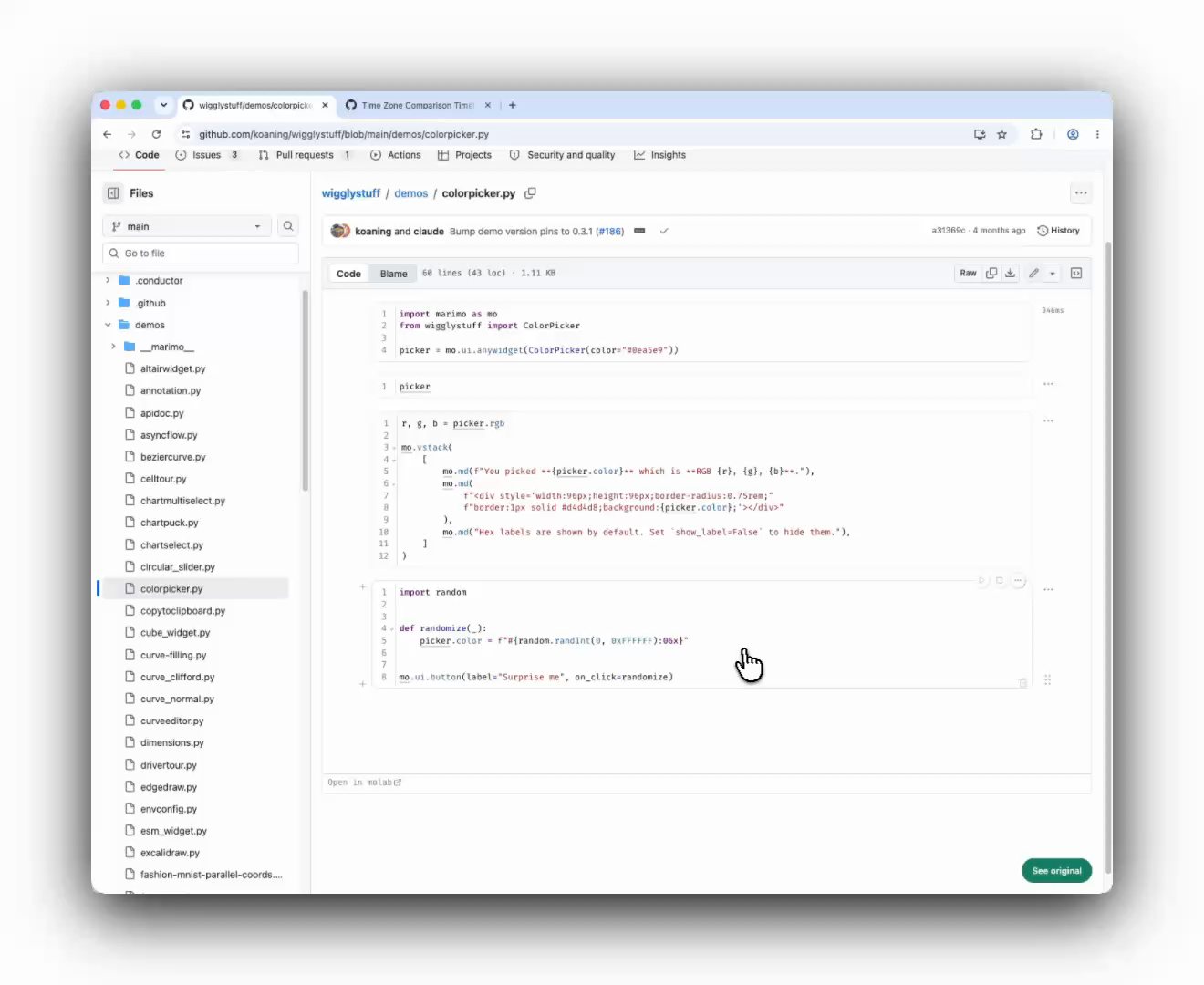
We also shipped marimo Glance, a browser extension that renders marimo notebooks on GitHub, gists, and GitLab as, well, notebooks, running in your browser via WebAssembly; it works on private repositories, too, because your code never leaves your machine (Chrome, Firefox, video).
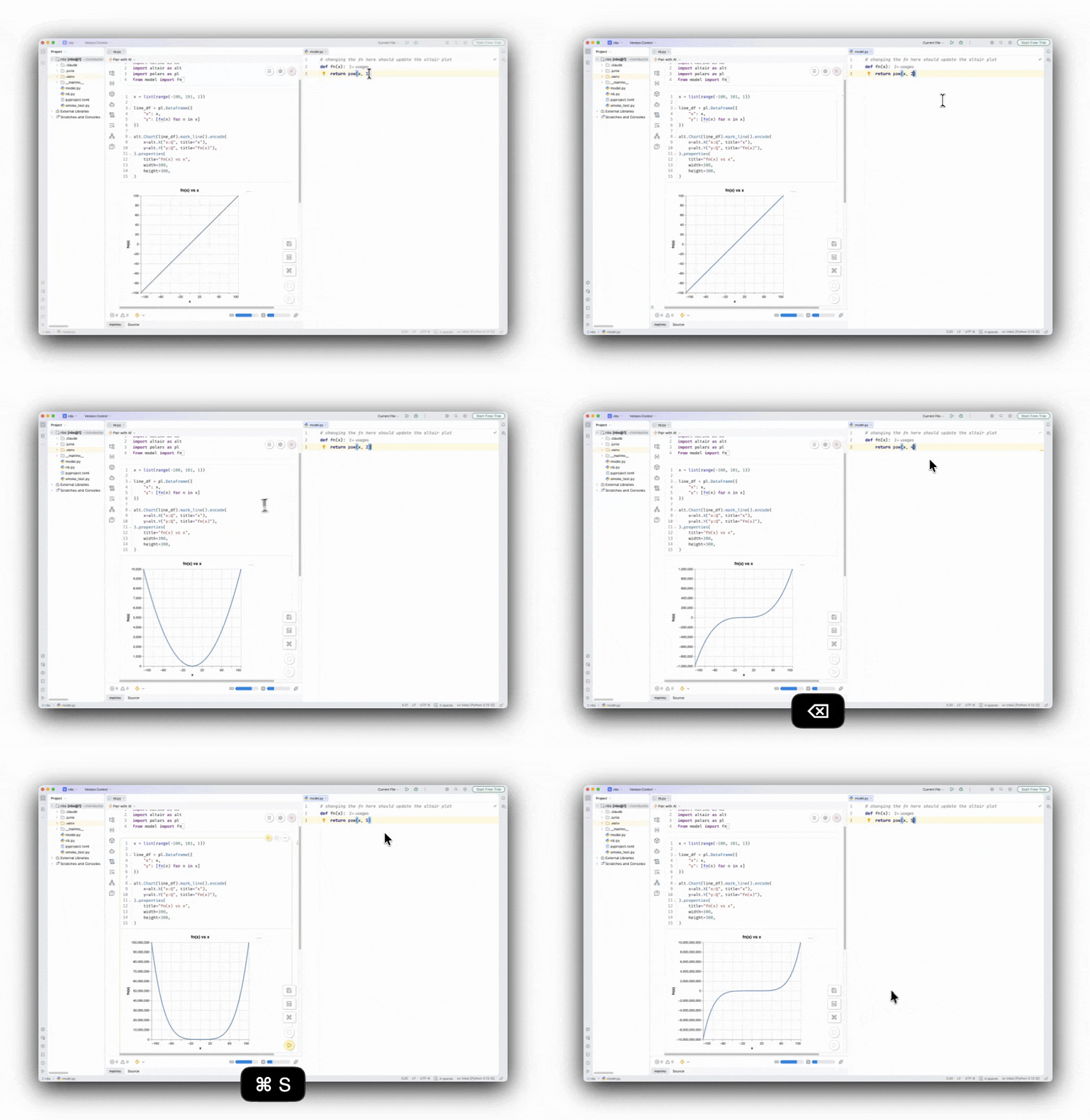
Wednesday: marimo in PyCharm. The marimo plugin for PyCharm brings reactive notebooks to PyCharm and other JetBrains IDEs, with cells that update as you edit your library code (blog, video).
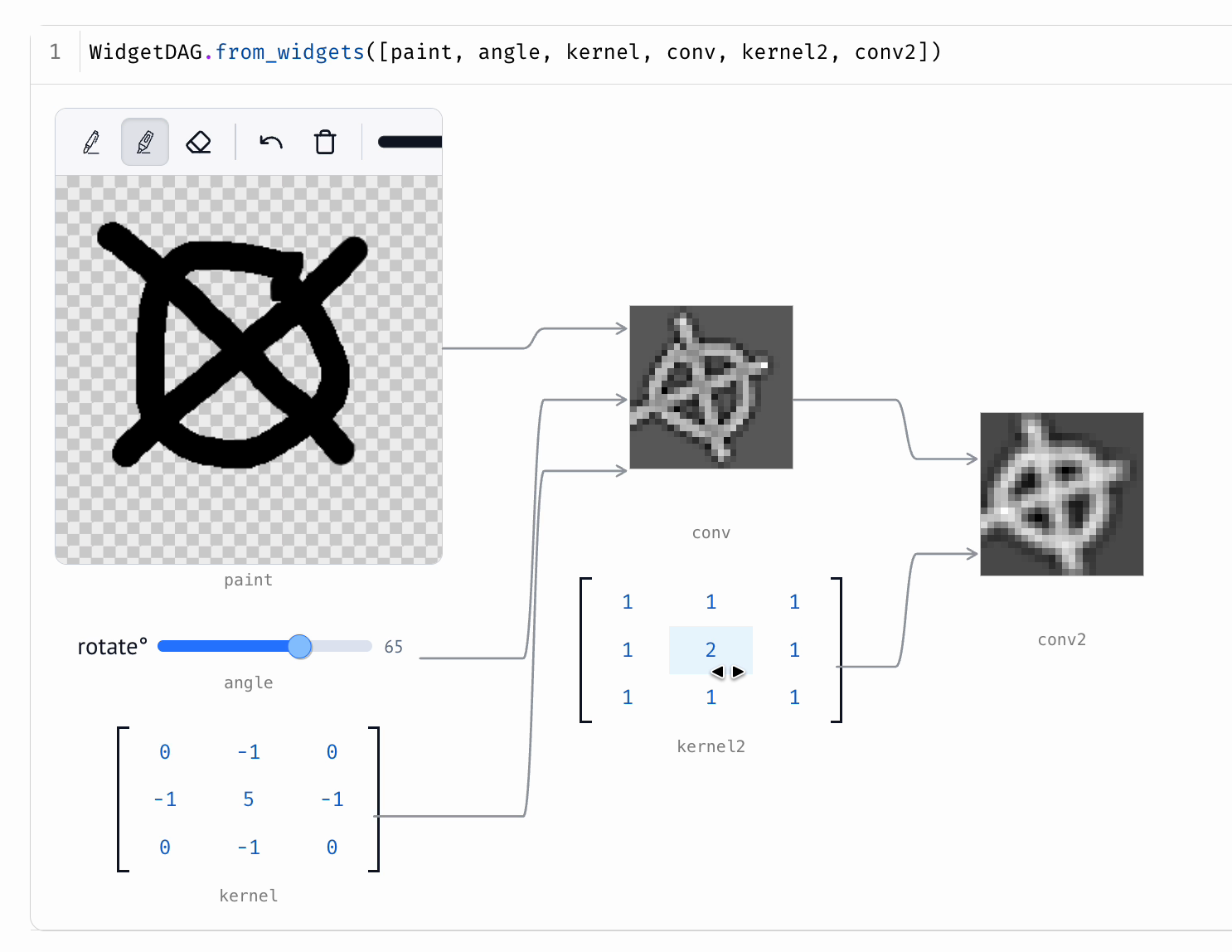
Thursday: eight new widgets. A new batch of widgets landed in the
wigglystuff library,
including
WidgetDAG,
which draws notebook variables as a live dependency graph
(video).
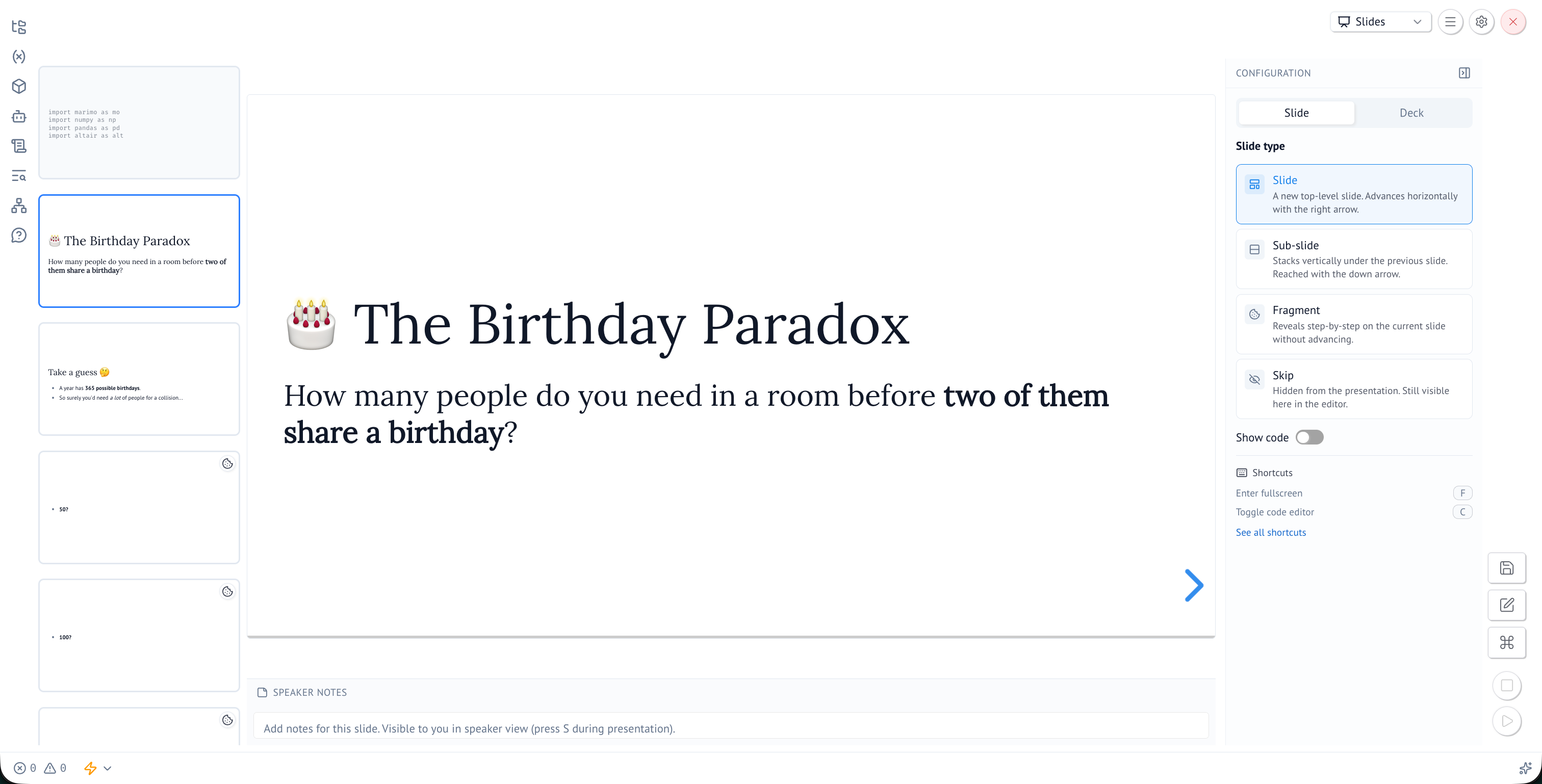
Friday: notebooks as slides. Present marimo notebooks as live, interactive slides, author the whole deck from a dedicated editor, and embed decks in any site via WASM (blog, video).
#What’s new on molab
Last month, we launched a public preview of molab on CoreWeave, providing GPU compute, substantial CPU and RAM, and longer sessions, all for free. Our new and improved molab is far more powerful than Google Colab, and unlocks many new use cases. Here, we’re excited to highlight a new feature and one awesome use case from our community.
#Google Drive integration
molab notebooks can now read and write files in your Google Drive. Run the tutorial notebook on molab to get started.
#Training coding agents
Kishan, a computer science student at Srinivas University, wrote about training his own coding agent on molab. He fine-tuned Qwen2.5-Coder-7B into Chitti, a coding agent that runs entirely on local infrastructure, and did all of it in marimo notebooks on molab’s NVIDIA RTX PRO 6000 GPUs: dataset curation, fine-tuning, benchmarking against DeepSeek-Coder-7B and the base model, and even a chat interface served straight from a notebook. His development notebooks are shared on molab, so you can retrace every step. Read the guest blog for details.
#Engineering grid flexibility at scale: why Voltus chose marimo
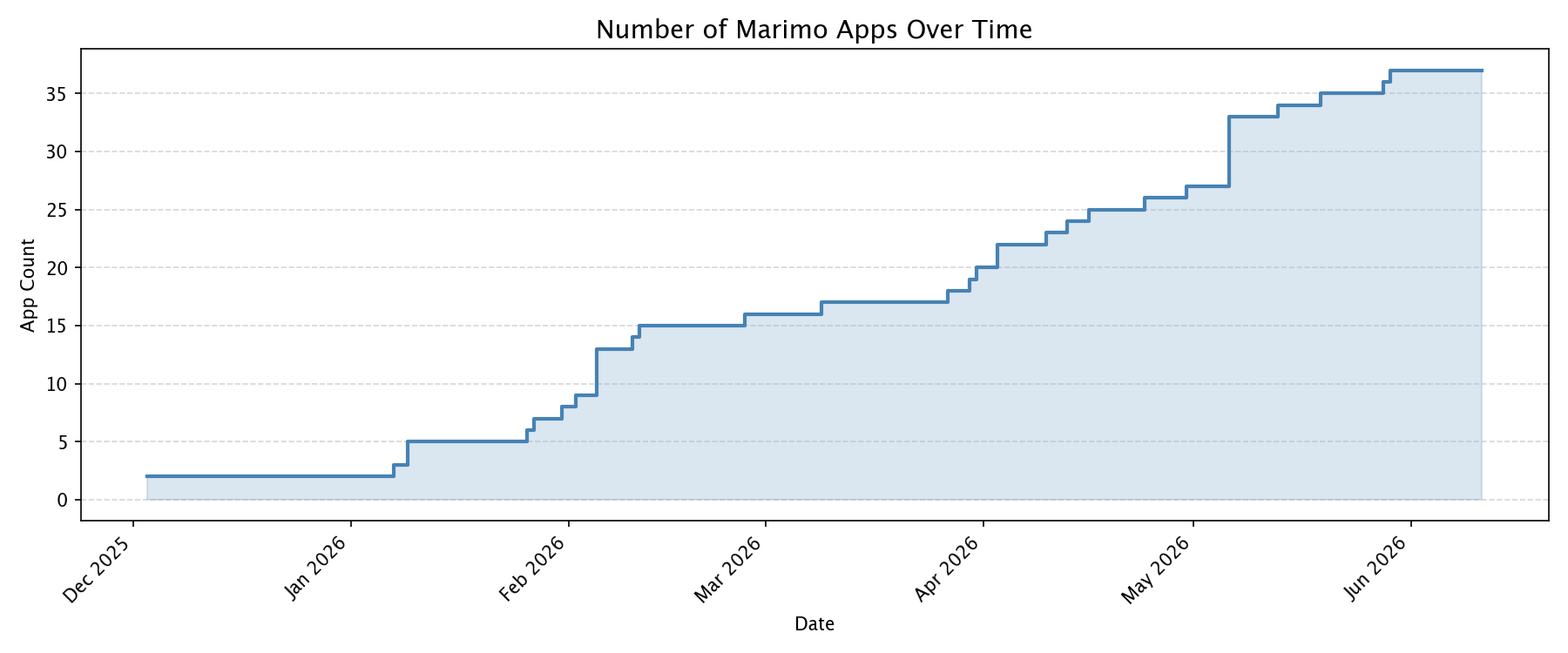
Voltus, the #1 virtual power plant aggregator in North America, wrote about how they use marimo to build auditable, cross-functional tools for the power grid. Teams across Energy Markets, Dispatch Operations, and Engineering work in the same notebooks, and their marimo app count grew from 2 to over 35 in six months. In the words of Will Lachance, staff software engineer at Voltus:
What surprised and delighted us about marimo was that it didn’t force a tradeoff — we got the reproducibility and auditability we needed for a regulated, high-stakes environment, while actually making our workflows more accessible and enjoyable to use.
#New features in marimo open source
Since our last newsletter, we’ve shipped seven releases (0.23.9 through 0.23.15). Here are some highlights.
Smarter AI chat. The chat sidebar gained a code mode:
instead of only suggesting edits, the assistant runs code against the live
notebook kernel, using the same machinery as marimo pair
(#9956). The panel can
also now search and fetch from the web
(#10052), attach cell
errors and tracebacks as context via @error://all
(#10038), and route
failing code straight into the sidebar with “Fix in chat”
(#10024). Prompt caching
is enabled for supported providers.
Cached WASM exports. marimo export html-wasm --execute now bundles
runtime cache into the export, so you can share interactive snapshots of
executions that can’t run in the browser at all, like a torch or JAX training
run, while the rest of the notebook stays live
(#9897,
#9895).
Anywidget composition and hot reload. marimo supports anywidget’s new composition API, which lets parent widgets render child widgets they were handed as values. Widget frontend code also hot-reloads in place as you edit it, with widget state intact (#10127).
An experimental visual debugger. marimo can now watch cells as they run,
highlighting the currently executing line and supporting debug points
(#9970). Built on the same
machinery, the experimental line_timing flag shows an elapsed-time pill on
any line busy for more than ~500ms
(#10126).
Threading and multiprocessing in WASM. WebAssembly notebooks can now run code that
uses threading and multiprocessing, via adapters that keep mo.Thread and
the stdlib primitives working in the browser
(#9839). Under the hood, the
code remains single-threaded; these patches are meant for compatibility, not
performance.
Clear console output mid-run.
mo.output.clear_console() clears a
cell’s console output while it’s still running, and the clear sticks across
reconnects and exports
(#9950).
#Trending on YouTube
Here are the most-watched videos on our YouTube channel since the last newsletter:
- Python is Better Than Powerpoint Now, a tour of the new slides feature.
- torch.manual_seed(3407) is All You Need, on the paper of the same name.
- Stop teaching MNIST like it’s 2012.
- A New Era of Python GUIs, the launch week
widgets video, featuring
WidgetDAG.
New videos come out several times a week. Subscribe to stay up to date!
#Notebook competition #2: the results are in!
We wrapped our second notebook competition with alphaXiv. Participants implemented AI research papers as interactive marimo notebooks, and because molab now has GPUs, this round included transformers, diffusion models, and larger-scale training. We received 80+ submissions and announced the winners at a joint virtual event with the alphaXiv team on July 14.
Without further ado, here are our winners:
First place: Eric Ma. Back to Basics: Let Denoising Generative Models Denoise (video explainer)
Second place: Konstantin Taletskiy. LLM-BABYBENCH: Understanding and Evaluating Grounded Planning and Reasoning in LLMs (video explainer)
Third place: Antonin Peronnet. The Shape of Beliefs: Geometry, Dynamics, and Interventions along Representation Manifolds of Language Models’ Posteriors
Congratulations to the winners, and thank you to everyone who submitted!
#Community roundup
We’re at 22k+ GitHub stars, 300+ contributors, hundreds of visitors on Reddit, and 4k+ members in Discord — join the conversation!
Here are some mentions of marimo in the wild that we found particularly inspiring.
#molab notebooks
Generative chemistry. The Matter Lab at the University of Toronto published a research paper on Clari, a generative model that predicts organic crystal structures in seconds, alongside a try-it-yourself molab notebook.
A literal random forest. Fabio Scantamburlo, an engineer at Nielsen, visualized a random forest as an actual forest of trees (molab notebook). We liked it so much we made a video about it. He has since released it as prettyforest, a pip-installable widget that works natively in marimo.
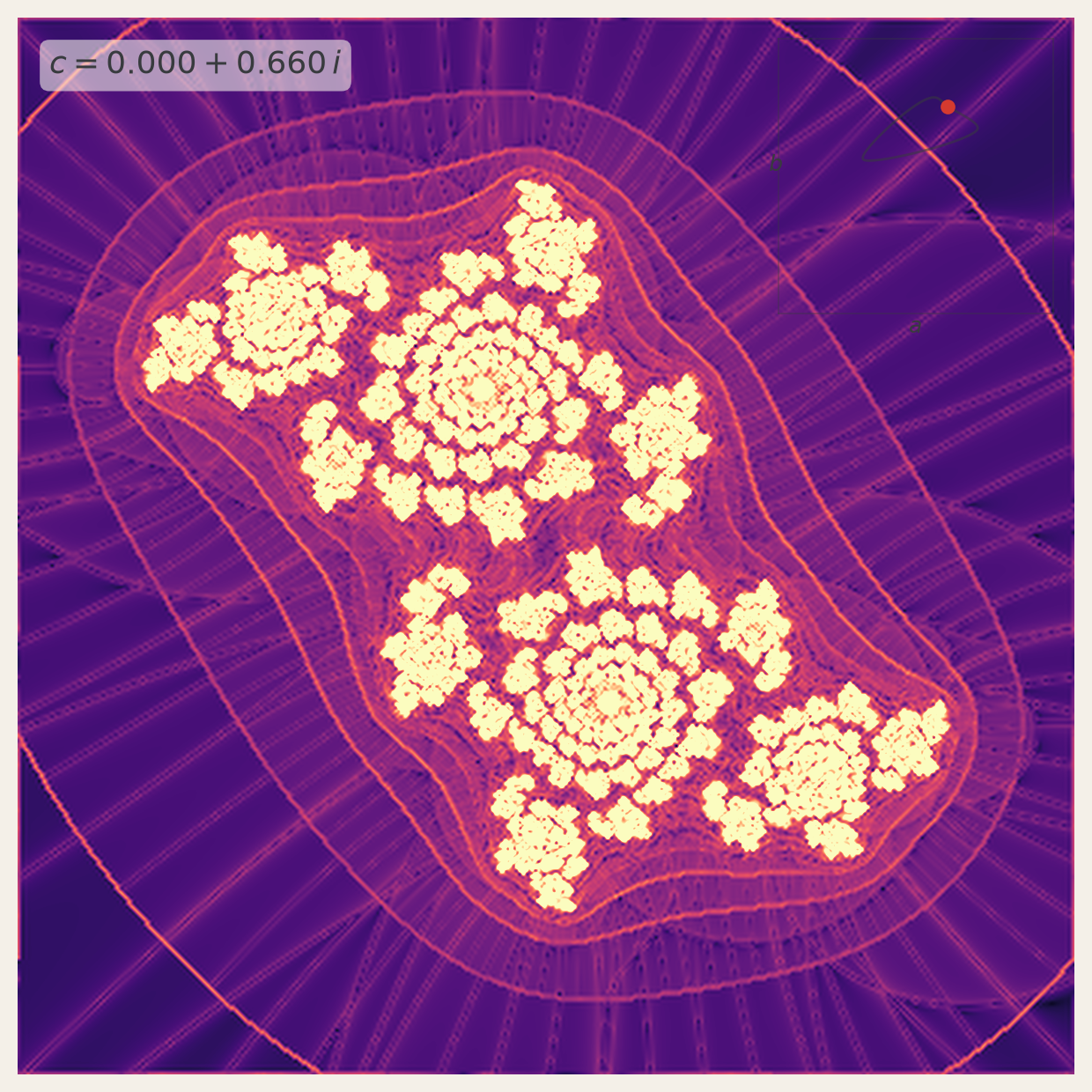
Math as art. Simone Conradi shares math art and optimization experiments built with marimo and wigglystuff, from GPU-computed Julia set animations on molab to an Italian Maturità exam geometry problem solved two ways: with simulated annealing and with differentiable programming.
Climate data homogenization. Benjamin Gutzmann, a maintainer of wetterdienst, rebuilt Rucola, a framework for homogenizing meteorological time series, and wired it into a marimo notebook that runs the full pipeline across 380 Saxon precipitation stations in a couple of minutes.
Race analytics. Kasia Kicler built the HYROX Performance Intelligence Platform, an end-to-end pipeline that turns official HYROX race results into performance insights with Python, SQL, and marimo. And Natalia Mazuch mapped pacing curves from HYROX race data, showing how athletes surge after the first station only to hit a wall on the final run.
#Conference talks
Applied math at SciPy. SciPy Conference spotlighted Michael Zargham’s SciPy2026 talk deriving the Homicidal Chauffeur pursuit-evasion game with SymPy and simulating it with NumPy and SciPy, all inside a marimo notebook that bridges textbook math and running code.
RAG evaluation at PyData London. Adam Hill gave a talk for PyData London 2026, “From Chat-with-PDF to Quiz-Master,” where he live-grades a RAG pipeline with an LLM-as-judge using Docling, DeepEval, and marimo.
#Elsewhere in the wild
Mathematical optimization. Mosek, which creates the convex optimization solver of choice for much of quantitative finance, moved its tutorial notebooks from Jupyter to marimo.
Interactive learning. Javier Garcia-Bernardo of Utrecht University published WASM-powered marimo apps for teaching Schelling’s segregation model and neural network overfitting.
A Stanford course on agentic software engineering. Mihail Eric is partnering with marimo in his new Stanford course, The Modern Software Developer, where students contribute weekly to real open-source projects such as Pi, Warp, and Unsloth.
marimo, rebuilt inside marimo. Konstantin Taletskiy of Anaconda rebuilt marimo’s reactive engine from scratch as tinymo, AST parsing and dependency graph included, inside a live marimo notebook. He also built Wanderland, a 3D learn-to-code playground for kids that runs as a notebook widget.
Agents and Bayesian modeling. Competition winner Eric Ma built a Bayesian hierarchical model of protein melting points in 27 minutes with marimo and a coding agent, then reflected on how agents amplify both expertise and ignorance.
Cell biology at the Broad. The Broad Institute released JUMP eXplore, a set of agent-composable marimo notebooks for analyzing JUMP Cell Painting data.
Incident response. Kyrre Wahl Kongsgård, who previously wrote about DNB’s Cyber Defense Center adopting marimo, shared an agentic, multi-SIEM incident response notebook framework built on marimo and marimo pair, with worked examples spanning vulnerable-driver hunts, C2 detection, and alert triage.
#And now for something visual
Here’s a visualization of a Julia set, made by Simone Conradi using a GPU-powered notebook on molab.